Tag: organize

  • No More Resolutions, Ever.  

    No More Resolutions, Ever.  

    I’ve never been a person who stuck with resolutions… but then again… how many people really are? The idea of starting new, getting motivated and being ‘perfect’ in the dead of winter, right after Christmas, with not much to look forward too is kind of odd, isn’t it? 

    Not to mention the fact that we are still in the middle of a global pandemic accompanied by a horrible market for pretty much everything from houses to gas to tomatoes at the supermarket. 

    I’m not trying to be a total downer, but let’s all just admit it. It’s hard right now. I mean, it’s hard anytime to rework yourself, but in the middle of winter? Who decided that? 

    Anyways, after much consideration on whether I even wanted to plan anything productive for myself to work on at all or if I just wanted to crawl into bed and do the bare minimum… I have come up with a new plan. Not resolutions, intentions.

    “If You Fail to Plan, You Are Planning to Fail”

    Benjamine Franklin

    So, I’m obsessed with my Bullet Journal. If you’ve never heard of the Bullet Journal method and Ryder Carroll’s book, I would highly recommend at least looking into it. Recently, he had a seminar about setting up your Bullet Journal for 2022, which I watched back after it was recorded.

    One of the biggest takeaways I got from this seminar was a different approach to being productive. No more resolutions doesn’t mean nothing will get done. In fact, hopefully it means more will.

    A resolution is a commitment to an outcome, but there’s no way to know an outcome.
    You’re committing to something that’s out of your control. For instance, what if… say… a crazy infectious virus appears and shuts down all the gyms, makes it horrible to find a decent apartment at a good price and lowers the overall frame of mind of everyone everywhere.

    Okay then, instead of resolutions… what? I can’t just do nothing.

    I know, I know, calm down. There’s still a plan. Goals. Goals are the definition of an outcome. And plans are a definition of a process. 

    How do goals help when resolutions don’t? Because they go hand-in-hand with intentions. My new favorite things. 

    Goals are there to help you experience something. Why exercise? To feel more comfortable in your own skin. Why organize? To be more motivated at home. This is where intentions come in. 

    Intentions help us be something. 

    I want to feel more comfortable in my own skin.

    I want to be motivated at home. 

    Goals are there to help you identify how to be a certain way. To see if these experiences align with who we want to be.

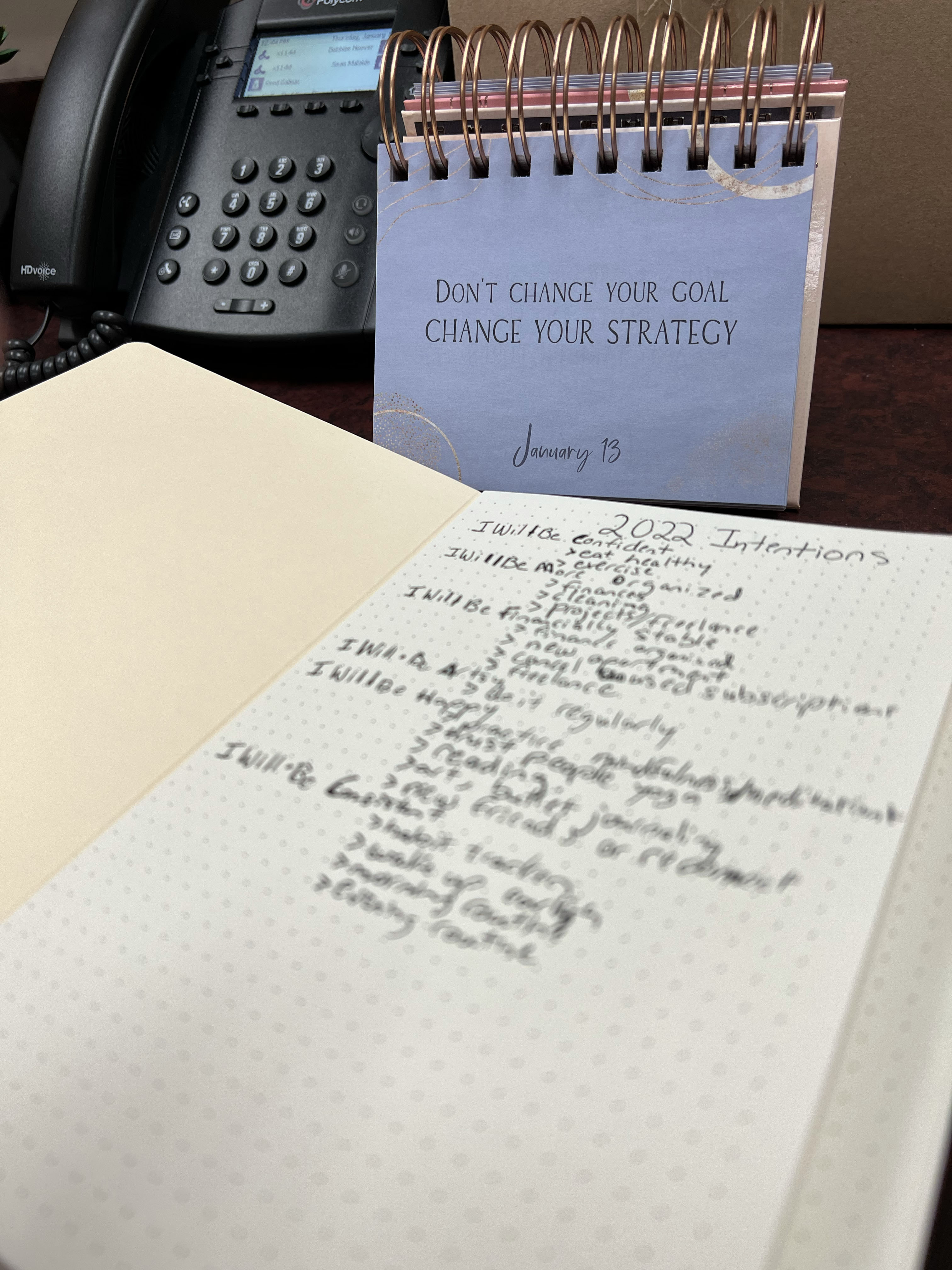
    Last week I set my intentions for 2022. Nothing too crazy and I tried to keep it simple and not add too many. In case you’re super curious or just want to keep tabs on me to see if I follow through, here are mine. The first sentence is my intention, the bullet points under are my goals to get to that intention.

    Speaking of keeping tabs, seeing as one of my intentions is ‘I will be consistent’, I think it will be a great idea to share the progress of my intentions through my social media channels. One of my favorite intentions I made was ‘I will be artsy’. In line with this intention, I have signed up for a wonderful visual journal class, which I am starting today. Yay! 

    Anyways, I hope you all are staying warm and stay tuned for more updates on my progress! Here’s a little sneak peak at the first page of my visual journal.

  • Organize and Prioritize Your Life

    Organize and Prioritize Your Life

    Well hello there and Happy Friday! As you may have noticed… I haven’t posted anything yet this week! That’s mainly because I found myself struggling to keep up with everything, so I decided to take a little break and organize, prioritize and plan everything I need to do for the next couple of months.

    Now I know on Friday the last thing on your mind is to set up your goals and to-dos… but honestly I’ve found this is the best time to do it. 

    Your mind isn’t focused on what all you have to do that week. You’re in a good mood and excited for the weekend. And once you write everything down and organize it, you can relax during the weekend knowing you have a plan. 

    So here’s my approach at prioritizing and organizing my endless to-do list. 

    STEP 1: BRAIN DUMP

    First, write everything down: Personal and work tasks should be captured in one place.

    If you have long-term goals, break them down into yearly, monthly, and weekly achievements. This is your Master List.

    Your Master List helps you understand how to prioritize all your tasks. But it can still get complicated when deciding what needs to get done now versus later. There are a few prioritization techniques I use that might help you separate the urgent from the important tasks.

    STEP 2: PRIORITIZE

    Employ the urgent-versus-important method: Prioritize urgent and important tasks; set a specific time to work on important non urgent tasks; and delegate or remove all other tasks. 

    In this case, you can use the Eisenhower Matrix.

    In basic terms, urgent tasks are things you feel like you need to react to right away, like emails, phone calls, texts, or news. While important tasks are ones that contribute to your long-term mission, values, and goals.

    When looking at how to prioritize tasks best, ask which one of the quadrants they best fit in:

    Urgent and Important: Do these tasks as soon as possible

    Important, but not urgent: Decide when you’ll do these and schedule it

    Urgent, but not important: Delegate these tasks to someone else

    Neither urgent nor important: Drop these from your schedule as soon as possible

    STEP 3: DAILY TASKS

    Create a daily MIT list: Write down three Most Important Tasks that should be done that day. These tasks should always relate to your larger, future goals. Nothing else matters here. This is your primary focus for the day.

    Then, determine three medium priorities. Ideally, these should be subtasks related to your main priority. And, schedule no more than five small must-to-do- priorities, such as meetings, general chores etc. While these are important and deserve your time, these are smaller to-dos since they don’t require as much energy.

    STEP 4: DEADLINES!

    Create clear deadlines: Give yourself full visibility of deadlines, even when something doesn’t necessarily need a deadline, make one. It could be a year from now, as long as there is a date attached (which you can always change) so you don’t just forget about it or put it off forever.

    As a side note, I use Asana, a great free website and app to organize everything from laundry to client work that needs done.

    A few more small tips that are necessary to remember!

    Avoid distractions: Intentionally steer clear of competing tasks, especially as task difficulty increases. 

    Consider effort: When your task list is becoming too much, prioritize according to effort and breeze through those easier tasks more quickly.

    Be flexible and adaptable: Uncertainty and change are given. Know that your priorities will change, and often when you least expect them to. So plan for the unexpected.

    Know when to cut: Be realistic. You probably can’t get to everything on your list. After you prioritize your tasks and look at your estimates, cut the remaining tasks from your list, and focus on the priorities that you know you must and can complete for the day. 

    Then take a deep breath, dive in, and be ready for anything.